
Finding Fort Smith Residents
A search in the Fort Smith residents directory works best as a chain. Start with the fact you already hold. An address points straight to the county parcel roll. A name opens property, court, business, and marriage records. A rough era sends you to city directories, newspapers, census schedules, and maps. None of these rolls lists a whole household. The assessor card proves an owner. The court index proves a party. Read each record only for the role it actually proves.
Fort Smith sits in the Fort Smith District of Sebastian County. The county also runs a Greenwood District. When the location or filing history is unclear, a record can sit in the other district. Search spelling variants, keep dates with every result, and match at least two independent facts before joining entries for a common name.
- Search the Sebastian County property roll by owner or location. Keep the situs, mailing address, parcel number, and legal description separate.
- Use Arkansas VoterView only as an identity-based self-check. It is not a public street browser.
- Move from a parcel to the County Clerk's deed record, noting the Fort Smith or Greenwood recording district.
- Check public court and probate indexes by name, then confirm the role and disposition in the clerk's actual file.
- For older residents, consult Fort Smith Public Library directories, newspaper pages, local indexes, maps, and census schedules.
Note: A mailing address, owner name, registered agent, and present occupant are four separate facts. Never merge them without support.
Fort Smith Records Custodians
Three desks anchor the Fort Smith records. The Assessor holds current parcel identity and ownership. The County Clerk records deeds, mortgages, liens, plats, marriage licenses, assumed names, and election material. The Election Commission conducts and tabulates elections. The County Clerk remains the registrar of voters. Court and probate files sit with the Circuit Clerk, not with the recorder of deeds. A precise request names the record, the district, the parties, and the date range.
Sebastian County Clerk/Recorder
35 S. 6th St., Room 102
Fort Smith, AR 72901
479-782-5065
Sebastian County Assessor
35 S. 6th St., Room 105
Fort Smith, AR 72901
479-784-1516
Sebastian County Election Commission
40 S. 4th St.
Fort Smith, AR 72901
479-784-1564
Both offices open on weekdays. Research counters at the county Assessor and Clerk run from 8 a.m. to 5 p.m. When a web tool stalls, phone first. Learn which desk keeps the record you need. Then inspect it at the counter or send a narrow written request. The full address sequence lives in the Fort Smith street directory.
The Sebastian County Clerk page shows how the county routes deed, marriage, DBA, and election work. It routes each task to its own service desk.
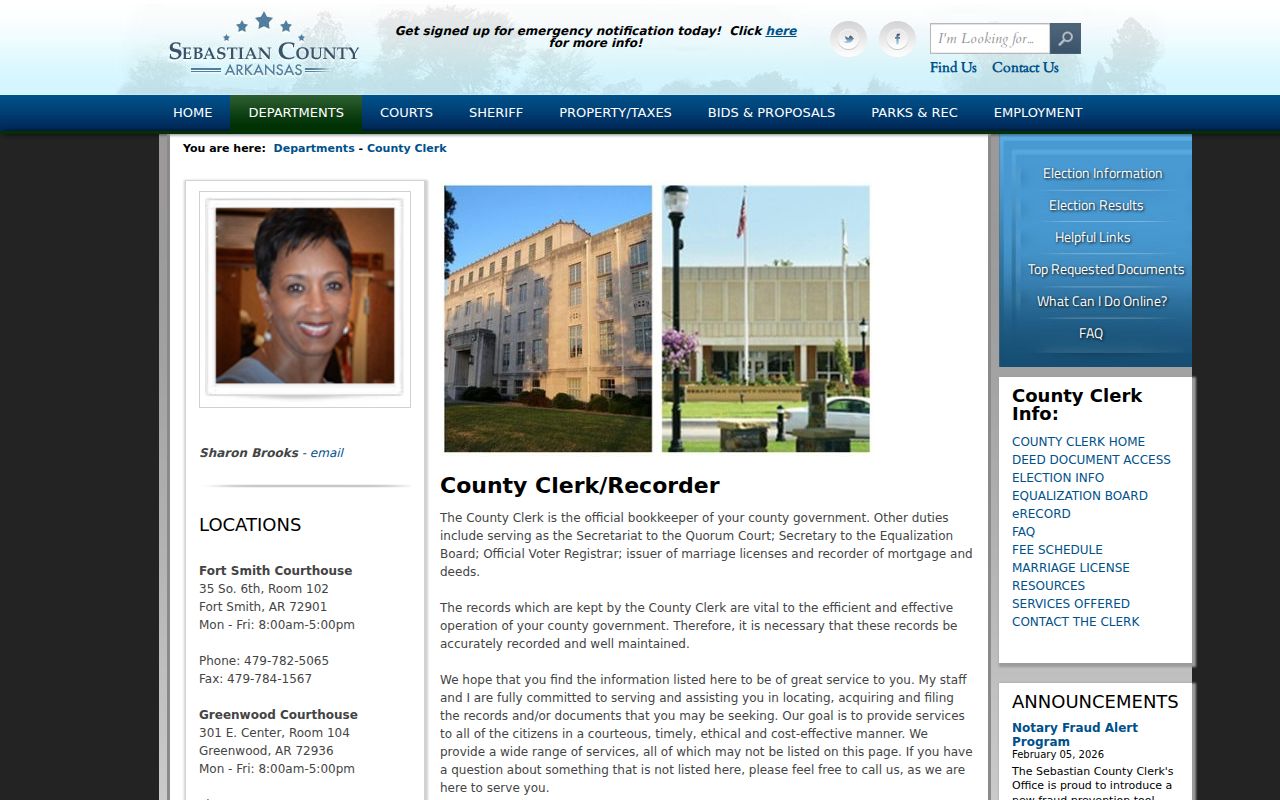
That hub sorts out which Clerk service handles a task before a counter visit or written request goes out. Start there.
Fort Smith Property Roll
The Sebastian County Assessor makes the best first stop for a current Fort Smith address. One record links the owner name, tax-mailing destination, and physical location. It also carries the parcel number, legal description, value, homestead credit, ownership history, and map. The physical location is the situs address. A parcel is the county's mapped unit of land. Neither fact proves who else lives there.
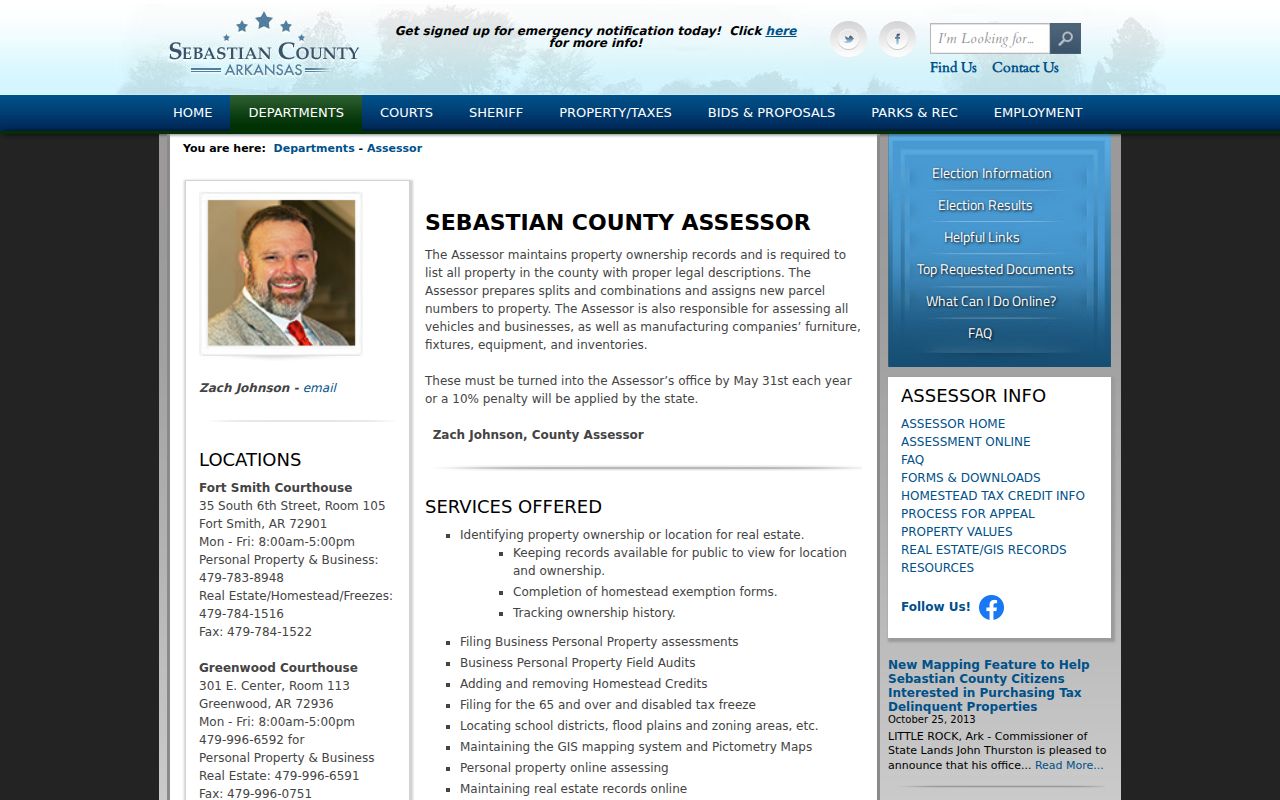
The assessor's screen points Fort Smith searches toward real-estate and GIS records. Room 105 counter help and a phone channel stay listed too.
- Roll
- An official list maintained for a public function, such as assessment or registration.
- Index
- A finding aid that points to a record; it may not show the signed document.
- Parcel
- A mapped unit of land tied to an assessment record and legal description.
- Criss-cross directory
- A directory arranged by street and address rather than only by surname.
Fort Smith Property Search Fields
The county supports searching by owner and by location. Search with what you know, then write down the major fields rather than pasting one address into every role. A homestead credit can back a claim of owner occupancy. It still will not list a whole household.
| Field to capture | What it establishes | Limit |
|---|---|---|
| Owner name | Assessed ownership | Not every occupant |
| Situs address | Physical parcel location | May differ from mail |
| Mailing address | Tax correspondence destination | May be remote |
| Parcel and legal description | Land identity for deed matching | Map is reference only |
| Ownership history | Prior assessed owners | Confirm with recorded deeds |
Match the record to a deed next. Use the parcel's legal identity to link them. The county GIS map is for reference only, can lag, and never replaces recorded plats or deeds.
Two Fort Smith Record Districts
Sebastian County has run two judicial districts since 1861. Fort Smith became a county seat in 1854, joining Greenwood. The split shapes every residents directory search, because land, court, and probate filings are indexed by district. Start with the Fort Smith District. Then check the Greenwood District too. A filing that misses in one district often sits in the other.
County history adds another boundary. Sebastian County was created in 1851 from parts of Crawford, Polk, Scott, and Van Buren counties. Pre-formation records live elsewhere. A parent county, a territorial source, a church register, or a federal record may hold them. Court and probate catalogs begin near organization. Marriage holdings reach to 1865, and wills begin in 1869.
Note: Record the district with every Fort Smith citation so a later search can return to the same clerk, index, and file series.
Current Fort Smith Directory Sources
No current Fort Smith residents directory lists everyone. Official rolls stay reliable when read for their stated purpose. Some sit free online, while others demand identity fields, a formal data request, credentials, or a courthouse visit.
| Local source | People or role shown | Keeper | Access route |
|---|---|---|---|
| Real Estate/GIS | Assessed owners and parcels | Sebastian County Assessor | Web link or Room 105 |
| Recorded instruments | Grantors, grantees, lien parties | County Clerk/Recorder | Credential route, counter, or request |
| Voter registration | Registration and precinct data | Secretary of State and County Clerk | Self-check or regulated file request |
| Public court index | Case parties and roles | Arkansas Judiciary | Search ARCourts, then clerk file |
| CityView | Applicants and contractors tied to city activity | Fort Smith | Address or parcel autocomplete |
| Library collections | Historical residents and events | Fort Smith Public Library | Digital, in-person, or staff research |
Official records have known custodians and clear correction routes. Commercial tools can blur the facts. Treat any compilation as an unverified lead, never as final proof of identity or place, since such databases merge names and carry stale addresses.
Fort Smith Deeds Beyond Login
The County Clerk's Recorded Deed Document Access page speaks to title and abstract companies, and a firm without credentials is told to request them. That gate does not close the record itself. Anyone can call 479-782-5065, visit the Room 102 counter, or ask staff to pull a known instrument using party names, an approximate date, the district, and the legal description.
A deed index lists grantors, who give up an interest, and grantees, who take it. The recorded image carries the operative terms. The public cutoff and open search fields are simply not published, so treat any claim of a fully open image archive with care. Counter staff will help, though a focused request goes further than a vague one.
The strongest residents directory trail ties an owner name to the recorded instrument and its matching legal description. Log the execution date and the recording date on separate lines, since they can differ. Note the role too: grantor, grantee, trustee, or lien party. Each role describes the document, never a current home address.
VoterView and Fort Smith Residents
Arkansas VoterView is a self-lookup. It asks for first name, last name, date of birth, and county, then can show registration status, polling place, and a sample ballot. It never browses a Fort Smith street. It never reveals ballot choices, and a non-match can reflect input, recent processing, inactive status, cancellation, or protected data.
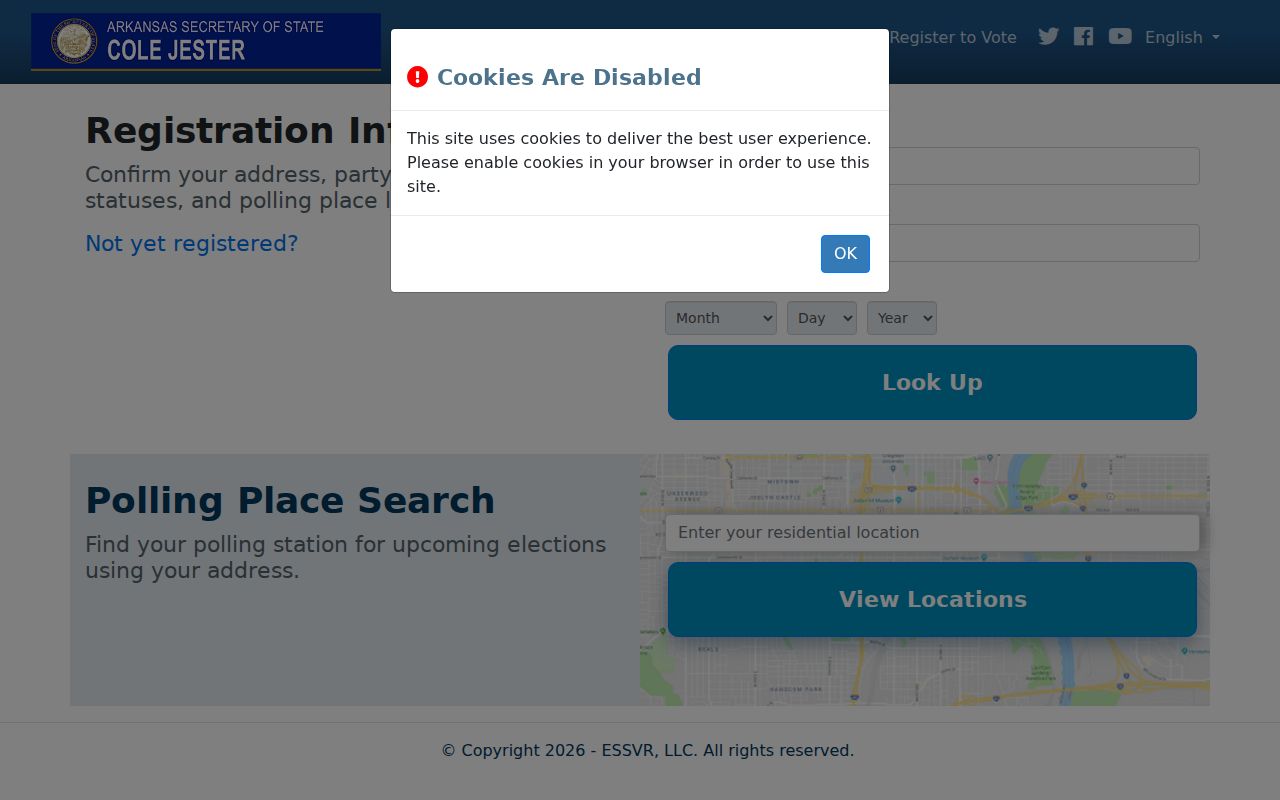
VoterView asks for identity details on each query. Those required fields shape how it fits a Fort Smith residents directory. It works best for confirming one named voter. It is not built as a street roster for browsing a whole block.
Broader voter-file requests follow a different path. The Secretary of State form governs them. Statute limits how the file may be used. Voters who qualify for protected status can apply through the secure-voter procedure under 7 CAR 23-103. The county then withholds their residence address along with the supporting papers. For registration help, the County Clerk sits in Room 102 and answers 479-782-5065.
Note: A missing VoterView result does not prove a named Fort Smith resident is unregistered. It also does not prove that resident lives elsewhere.
Fort Smith Court Index Trail
The state's Search ARCourts portal searches public case information. You can search by participant name, organization, or case description. Sebastian County recommends partial names. Partial searching catches spelling variants. A result can show court, case number, status, dates, party roles, attorneys, events, and disposition. Linked images are not uniform. Sealed, juvenile, adoption, or other confidential matters never appear as ordinary public records.
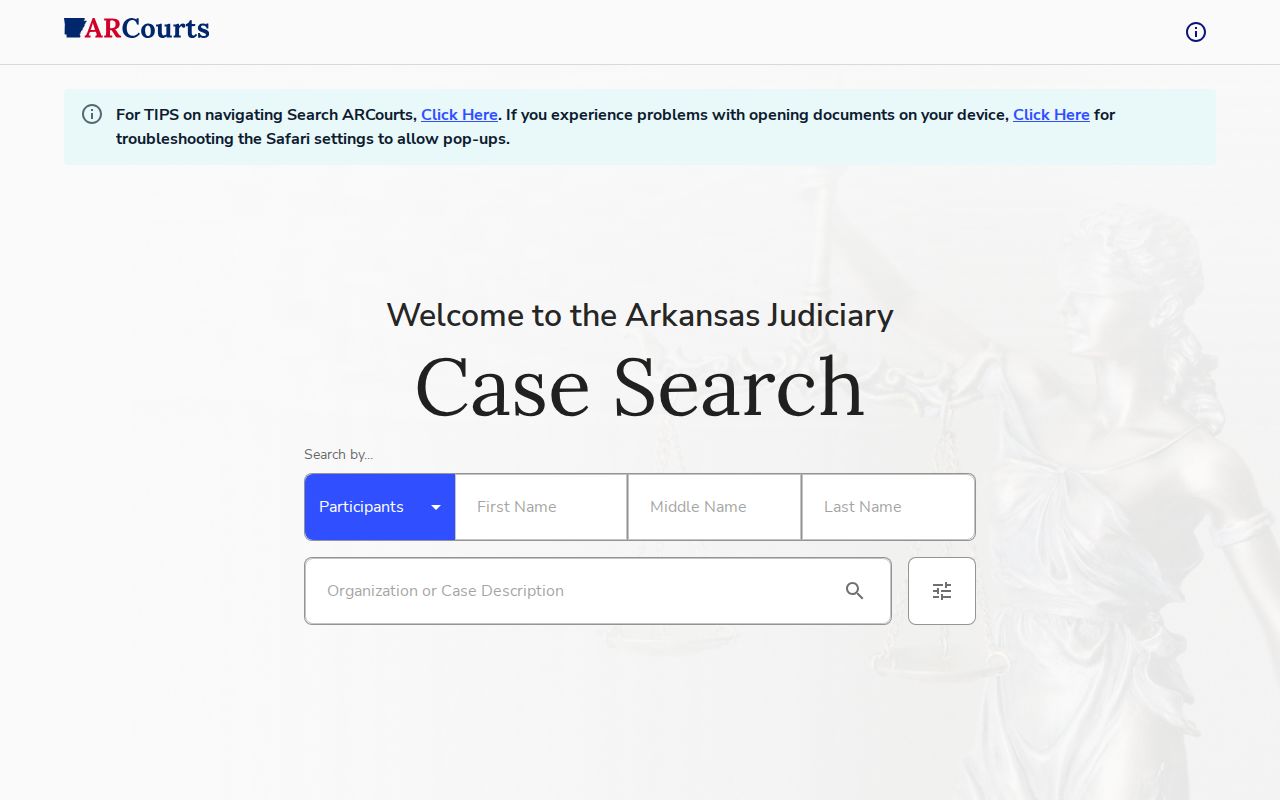
The search view is only an index. The Circuit Clerk's actual file controls when a fact or certified copy matters.
Documents before June 15, 2015 live in the Circuit Clerk's legacy imaging system and public lobby kiosks. Visit the records office in the Parker Annex. The address is 40 S. 4th Street. A written request should list the party variant, the case number if known, the date range, and the copy type sought.
Fort Smith Vital Record Bridges
Fort Smith began civil birth and death reporting in 1881. Many events were never filed. Gaps are common. Library indexes stop at 1921 for births and 1924 for deaths. Local reporting ran to 1965. Statewide registration began in 1914. A missing online name means try another channel, not that no record exists.
The County Clerk holds original marriage records back to 1865. Arkansas Department of Health marriage coupons start in 1917, and divorce coupons start in 1923. Certified copies require eligibility, identification, and payment. Order online, by mail, by phone, at the state office, or through the Sebastian County Health Unit. Historical indexes, newspapers, cemetery records, funeral-home files, and probate can bridge gaps. None replaces a certified record.
Note: Match the requested document to its custodian. The original county file and the later state certificate are not interchangeable.
Historic Fort Smith Residents Directory
The Barbara Jones Walker Genealogy and Arkansas History Department at 3201 Rogers Avenue holds Fort Smith city directories from 1881 to the present, with gaps not fully itemized. The collection spans about 25,000 titles. Yearbooks, early funeral-home records, cemetery indexes, a Sebastian County marriage index, census microfilm, and local newspapers share the shelf. Genealogy materials are open-stack and noncirculating. Arkansas materials and originals are closed-stack.
A city directory captures a publication-year snapshot. Criss-cross sections reverse the search from an address to names. Moves between editions can vanish. Edition details and reading methods are treated on the Fort Smith city directory page.
Fort Smith Newspapers Since 1848
The Fort Smith Public Library newspaper archive carries page images and full-text search. It runs from 1848 through the end of 1973. New material appears as funding allows. Obituaries, social notes, legal notices, and sale ads tie a name to a date or a place. That makes the archive a natural partner to any Fort Smith residents directory search. OCR misses type, though. Try initials, alternate spellings, and a known relative when a first pass fails.
Library staff run a paid research service too. It costs $20 per hour with a 15-minute minimum. An obituary request is $5 per name and covers 15 minutes. It usually returns in three to five business days; the fee still applies when nothing turns up. That remote help matters for an old street directory, a microfilm roll, or an unindexed record. You cannot reach those online.
For an obituary, send full and maiden names. Include nicknames, parents, birth and death details, the newspaper, and any known publication date. A tight request lets staff test the name against the Fort Smith newspaper run and related cemetery or funeral-home material. It avoids drifting into an open-ended identity search.
Fort Smith Custody Index Limits
The Arkansas Division of Correction search takes identity and custody filters. It reports state custody data. County bookings, the state inmate locator, the offender registry, and court files each answer a different question. A booking is not a conviction. A registry follows statutory inclusion rules. A custody listing is never a full court history.
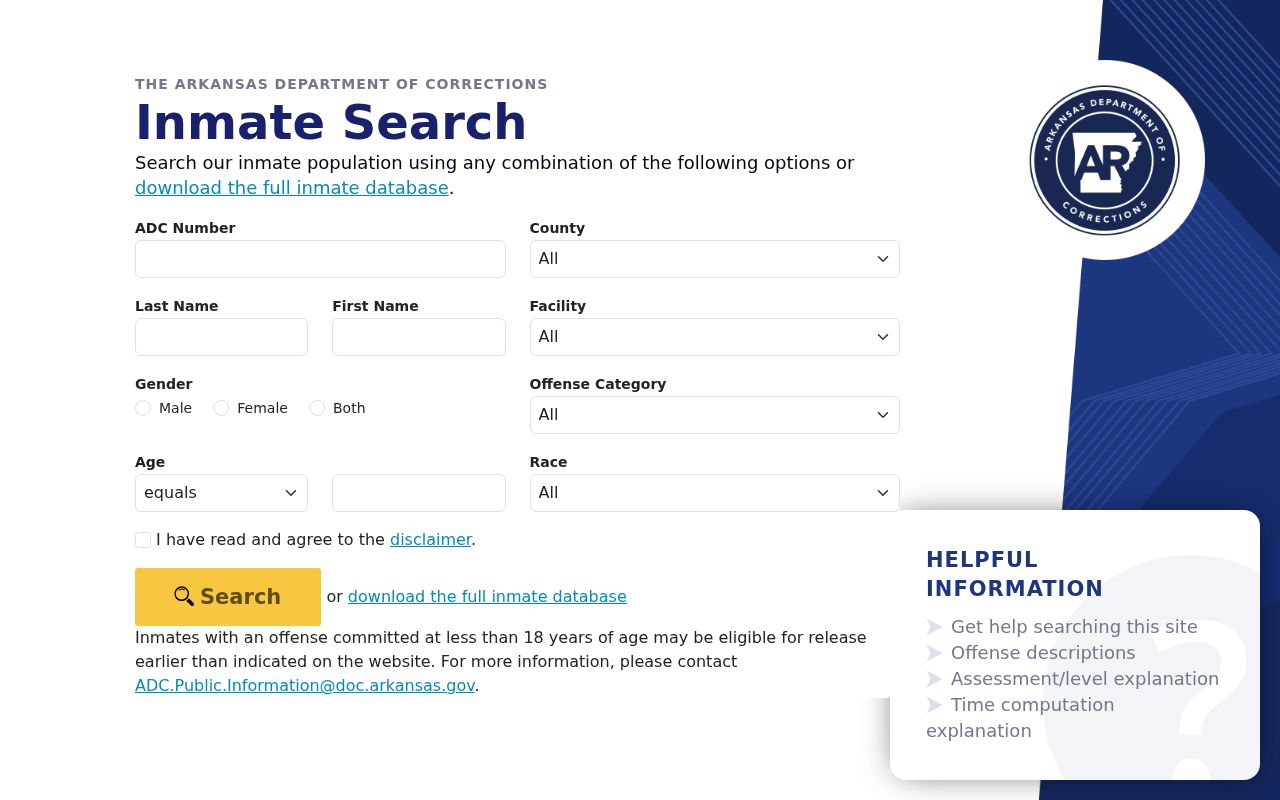
The results screen shows why custody entries must be checked against the named court and its final disposition. A listing is just a snapshot of one system.
The Arkansas offender registry supports identity and geographic searching for the public levels the law permits.
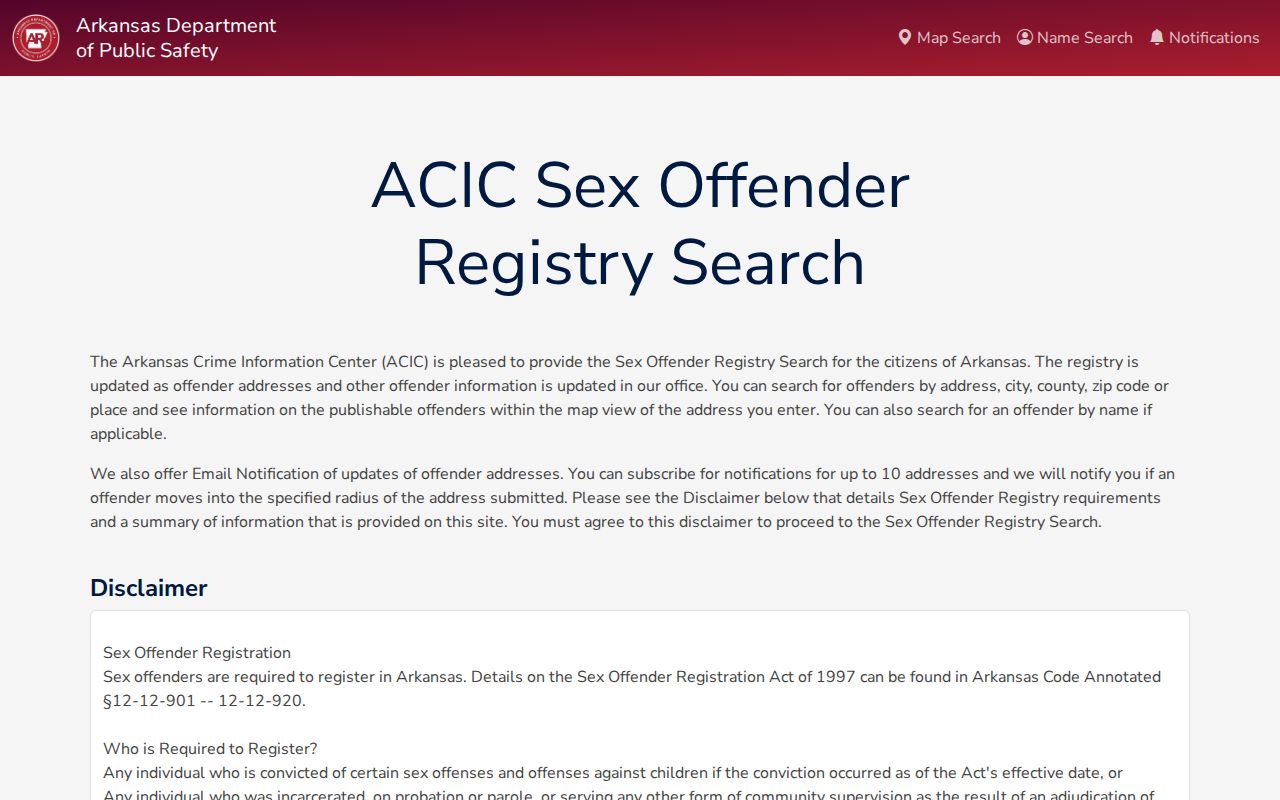
Registry warnings and public-level limits matter. Never treat the map as a complete list of everyone on a block.
Note: Confirm any custody or registry identity against the official case record, matching dates and roles before drawing any conclusion.
Fraud Alerts for Fort Smith Owners
Sebastian County opened a free Property Fraud Alert on March 31, 2025. It sends a call, text, or email whenever a newly recorded item is indexed under an enrolled owner name. More than one spelling variation can be registered. The service detects a filing; it does not block a transfer or guarantee good title. An unexpected alert is a prompt, not proof. Check with the County Clerk and law enforcement.
A separate Notary Fraud Alert started February 5, 2026. Daily, weekly, or monthly notices can carry the document number, type, and parties whenever an enrolled notary is named. Both tools slot neatly into a Fort Smith residents directory workflow. They add monitoring without altering the deed record itself.
Enroll every likely spelling variant the service allows. If a notice arrives, compare its document number and parties with the Clerk's index, then pull the filed instrument. The alert watches owner-name indexing, not the truth of a parcel's title. Let it trigger review rather than settle anything.
Lawful use. Fort Smith public records are for lawful personal research. Arkansas law does not permit stalking, threats, surveillance, harassment, or harm merely because a fact is public.