
Fort Smith Lookup Record Map
No one roll proves where a person lives now. The Fort Smith resident lookup begins by choosing the record that answers the narrow question. The Sebastian County Assessor can connect an owner to a parcel, but its mailing field can point elsewhere. VoterView is an identity-based self-check. Search ARCourts can establish that a name appears as a party, yet the role and outcome still need review. Marriage, death, directory, and newspaper indexes add family or time anchors. Business and license files establish a public role, not a home.
| Record | What It Can Confirm | Custodian | Access Route |
|---|---|---|---|
| Property roll | Owner, parcel, situs, mailing destination | Sebastian County Assessor | Online records, Room 105, or phone |
| Court and probate | Party role, case status, estate role | Circuit Clerk and District Court | Search ARCourts, legacy imaging, kiosk, counter, request |
| Marriage and vital indexes | Spouse, event, date, county | County Clerk, ADH, FSPL | Index, eligible order, counter, library |
| Voter record | Registration and precinct for the subject | Secretary of State and County Clerk | VoterView self-check or lawful data request |
| Historical sources | Past address, family tie, school or event | Fort Smith Public Library | Library shelves, microfilm, digital newspapers, staff request |
Begin with the strongest known fact. An address points toward the assessor. A case number goes to the court file. A marriage date belongs with the County Clerk or Arkansas Department of Health, depending on whether the original license or state coupon is needed. That choice keeps a common name from turning into a false match.
Search Fort Smith Resident Court Names
Search ARCourts is the statewide starting point for a Fort Smith resident lookup involving public court files. Participants mode accepts First Name, Middle Name, Last Name, and Organization or Case Description. The fields are individually optional, but the query needs meaningful input. Partial-name searches can surface spelling variants and aliases. Narrow the result by Sebastian County, then check the case number, party role, dates, and disposition. A name hit alone does not identify the right person.
The search screen can be seen in the official Arkansas Judiciary participant lookup shown here.
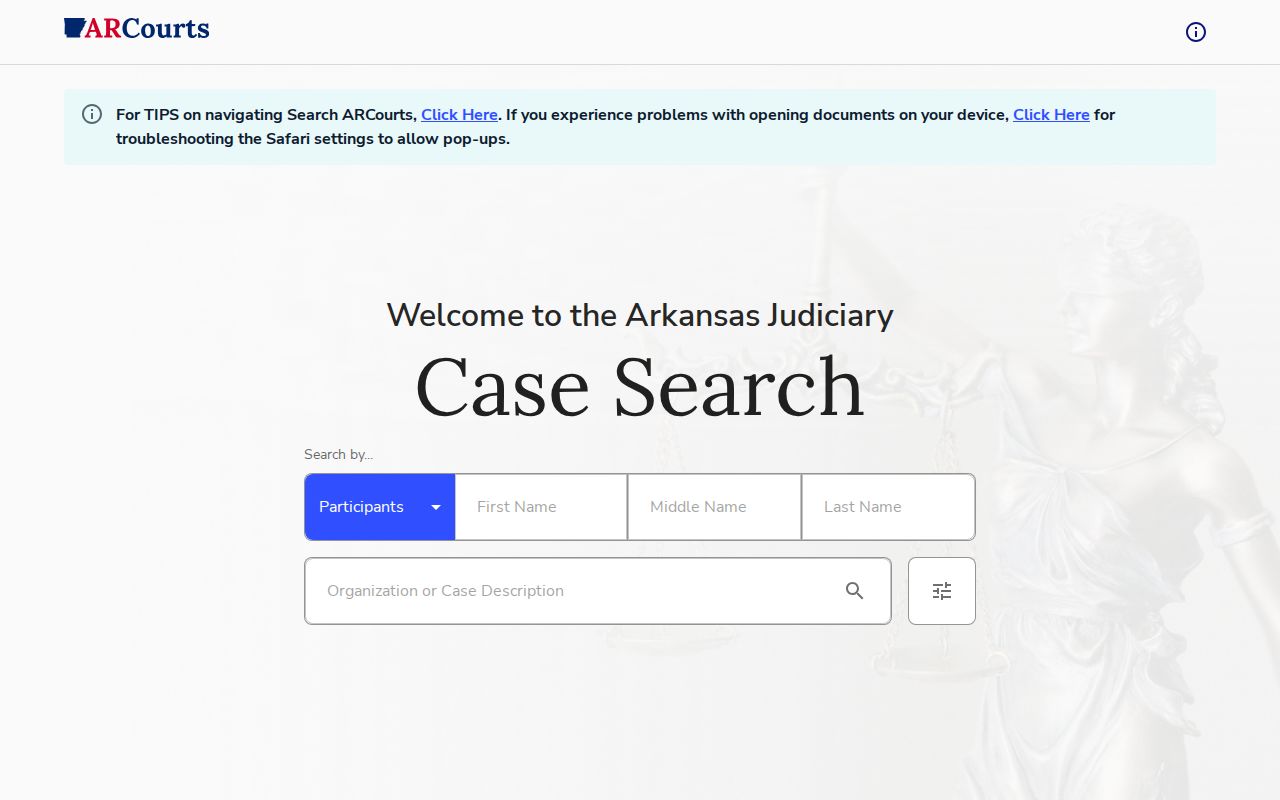
The form supports a name-first search, while the result must still be checked against Sebastian County and an independent identity anchor.
| Result Field | Why It Matters |
|---|---|
| Case number and court | Routes the request to the correct file and district |
| Party name and role | Separates a plaintiff, defendant, heir, or other participant |
| Filing and status dates | Tests whether the event fits the known timeline |
| Attorneys and disposition | Adds context and prevents a docket hit from being treated as an outcome |
| Document links | May be incomplete, so the clerk's official file remains controlling |
Juvenile, sealed, expunged, adoption, and other confidential matters will not appear as ordinary public records. Absence from the index is not proof that no file exists.
Fort Smith Resident Court Fallbacks
The Sebastian County Circuit Clerk holds the actual circuit and probate files. Its Fort Smith records office is at the Parker Annex, 40 S. 4th Street, and the public counter can supply guidance on existing records and copy options. The office also maintains lobby kiosks. For documents before June 15, 2015, the clerk directs researchers to legacy iSeries and imaging access. That system is case-sensitive, stores data in uppercase, and permits wildcards such as CV-2010*. The Arkansas Judiciary records guidance explains the separate request route for judicial administrative records.
The official clerk page shown below is the route for local file access and division contacts.
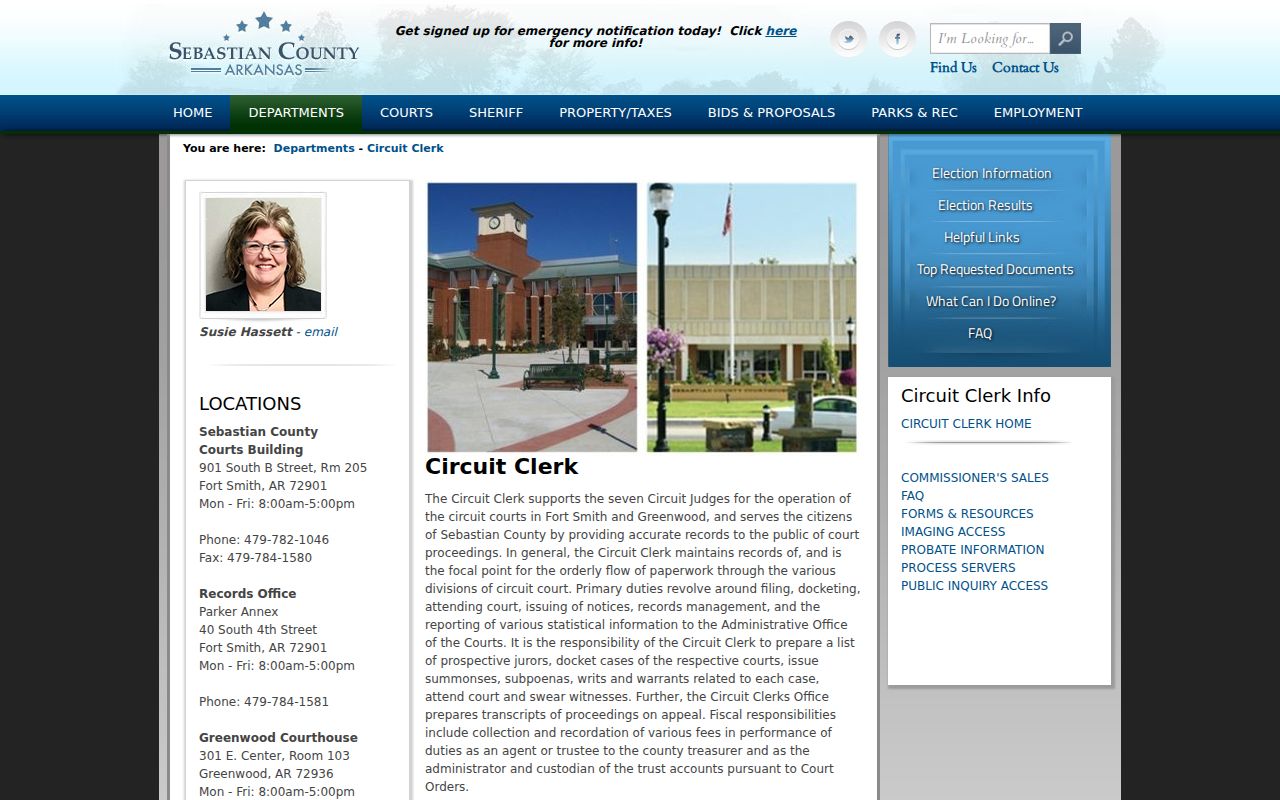
This office layer matters because an online summary cannot replace the filed document or a certified copy.
Fort Smith District Court has a separate local docket. Its records office accepts an oral or written request with enough identifying detail, and stored files may take three business days. The published rate is 25 cents per page, with $5 certified copies and $5 transcripts of judgment per charge. Federal cases belong to the Western District of Arkansas through PACER or the Western District clerk, not the county portal.
Note: Ask for the correct district, an exact case number when known, and the price of certified versus plain copies before ordering.
Confirm Fort Smith Resident Records
A reliable Fort Smith identity check uses two or three independent anchors. Normalize the name first. List maiden and married forms, middle initials, suffixes, likely spelling variants, and a known date or place. Then separate every role found. A parcel owner may not occupy the property. A registered agent shown in the Arkansas business entity search receives legal notices for an entity and is not necessarily the owner or a resident. A court party may share the same name as the subject. Preserve conflicts instead of forcing them into one profile.
- Search the Sebastian County Assessor by owner or location. Record parcel, situs, mailing destination, and legal description as distinct fields.
- Run Search ARCourts with the exact name and partial variants. Check county, dates, party role, and case status.
- Use a marriage, death, directory, yearbook, or newspaper index to test a spouse, event, address, or time period.
- When a fact matters, request the original file or certified copy from its custodian. An index is only a finding aid.
- Docket
- The court's chronological list of filings, events, and rulings in a case.
- Index versus image
- An index points to a record. The image contains the filed text and may require a separate access route.
- Certified copy
- A custodian-issued copy bearing official certification that it matches the filed record.
- Situs address
- The physical location of a parcel, distinct from the owner's tax-mailing address.
The best match pairs facts that are hard to confuse, such as the same legal parcel and deed party, or a spouse plus a compatible event date. A matching common name is weak evidence.
Fort Smith Resident Marriage Bridges
Marriage records can connect a surname change, spouse, date, and county. The Sebastian County Clerk marriage license route holds the original county record, with county holdings reaching 1865. Arkansas Department of Health marriage coupons begin in 1917. These are related but different records. The clerk's certified copy costs $5 under the published schedule, while a state coupon is ordered through the health department under its own eligibility and identification rules.
The county marriage service and its request path appear in this official source view.
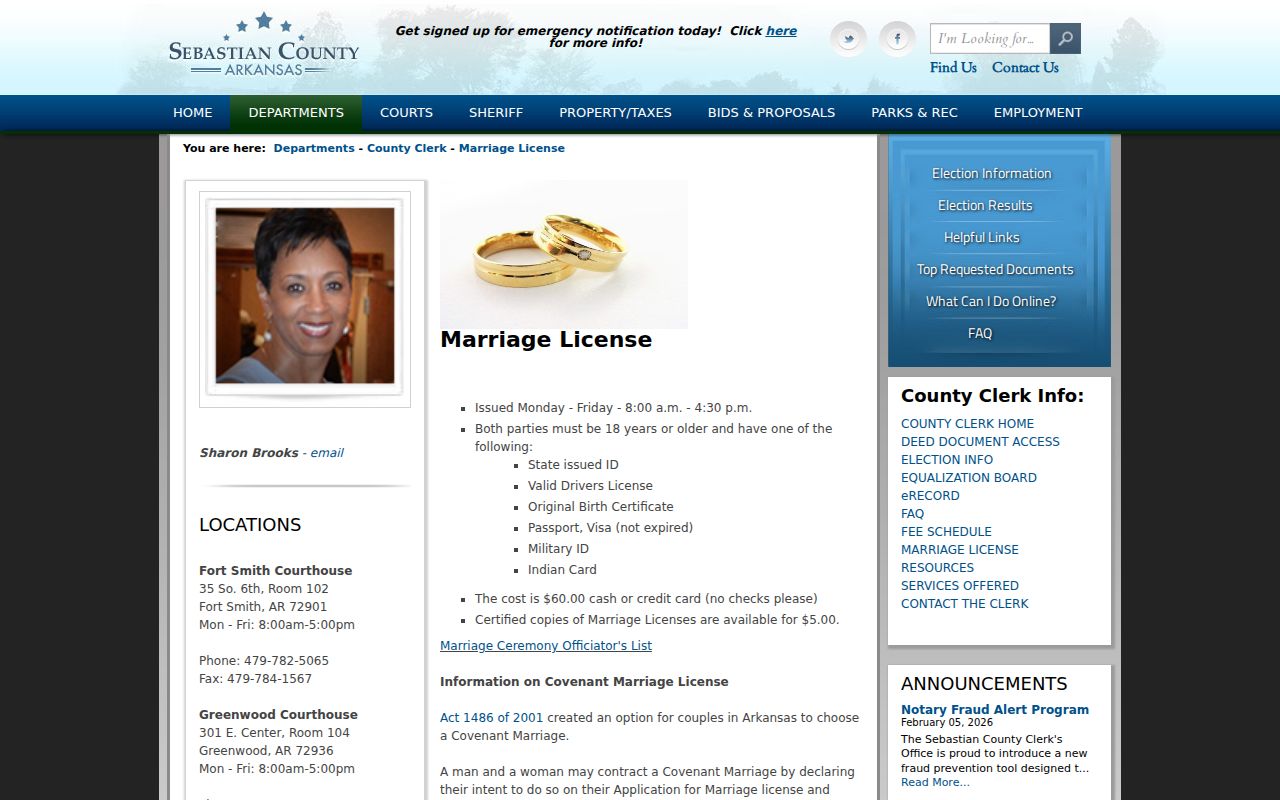
The source helps route a surname or spouse clue to the original local license rather than treating a state index as the full instrument.
For historical research, Fort Smith Public Library indexes Sebastian County marriages for 1847, 1861, and 1863 through June 14, 2001. Its city birth index covers 1881 through 1921, and its death index covers 1881 through 1924. The underlying local civil series extended longer and was incomplete, so a missing web hit can still justify a staff request. Recent vital certificates are restricted. Births generally reach genealogical availability after 100 years, while death, marriage, and divorce records use a 50-year rule.
Trace Fort Smith Resident Family Links
Probate is a strong lawful route when the goal is to identify an heir or close an estate trail. Search the decedent's name, then inspect the case for the personal representative, heirs or claimants, filed addresses, and estate deeds. All probate is indexed in the Sebastian legacy database, though confidential filings remain closed. Newspaper death notices and the library's cemetery and obituary material can support the same identity, but they do not replace the court file.
The Barbara Jones Walker Genealogy and Arkansas History Department offers an obituary request for $5 per name. It includes a 15-minute search and a digital copy if found, normally in three to five business days. A full research request costs $20 per hour with a 15-minute minimum. The fee applies to staff time even when no result is found. This fallback can resolve a Fort Smith resident lookup when the needed newspaper, funeral-home, or directory source is not online.
Adoption research follows a different path. Arkansas's voluntary registry and contact-preference process is confidential under Ark. Code §9-9-504. It permits direct or intermediary contact choices through the official program. Public databases cannot lawfully substitute for that protected procedure. For a different kind of name lead, the Great Arkansas Treasure Hunt can show reported unclaimed property, but a match requires proof to claim and does not establish current residence.
Correct Fort Smith Lookup Conflicts
When two official sources disagree, keep both versions and return to the office that created each record. The Circuit Clerk requires corrections to be requested in writing at PO Box 1179, Fort Smith, AR 72902-1179. An assessor issue belongs with the assessor. A city-held file can be requested through Fort Smith's public-record routing, while a state certificate issue belongs with Arkansas Vital Records. Clerks can explain their record process, but they are not identity investigators.
The County Clerk contact and request page is another documented fallback.
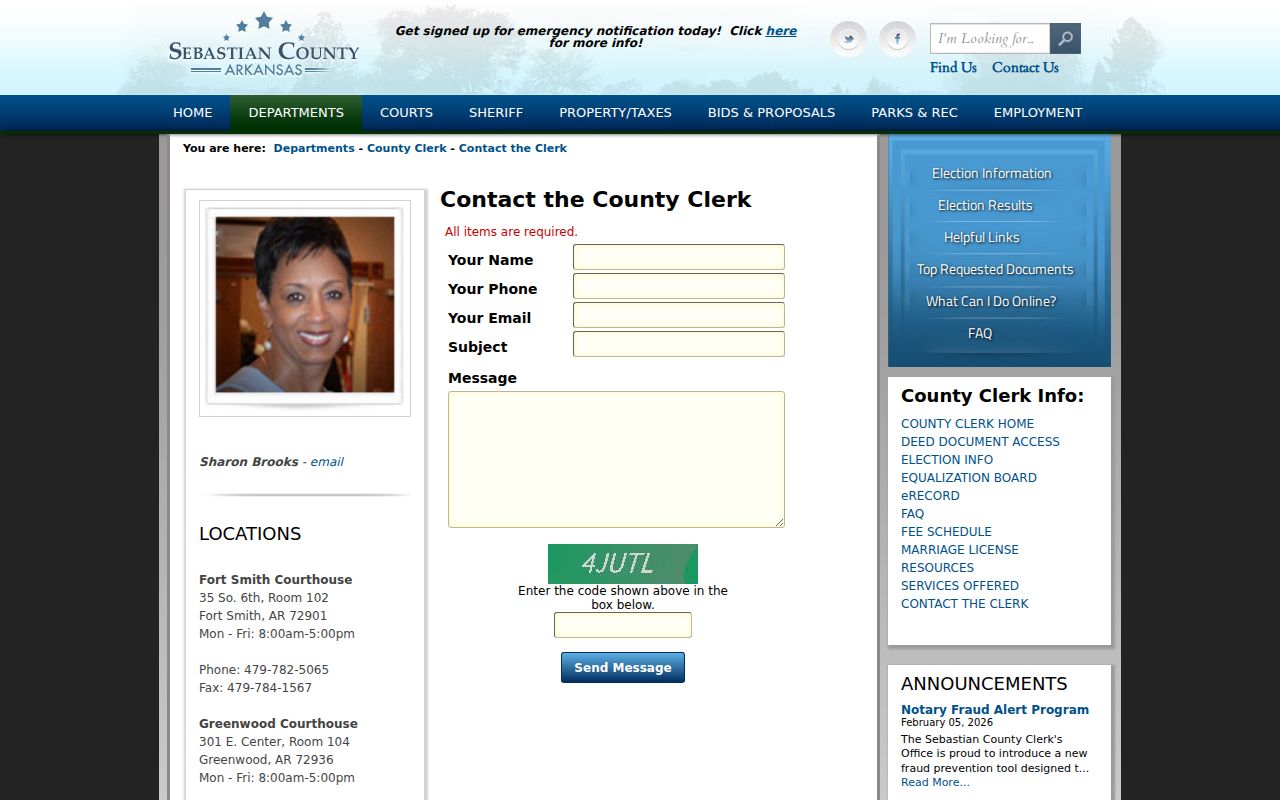
The page supplies the office route when a web index is gated, incomplete, or needs a custodian response.
Arkansas FOIA applies to existing nonexempt government records. A focused request names the record, office, date range, party variants, and preferred format. Records in active use or storage must be certified and made available within three working days. The act does not require an office to answer research questions or build a new identity report.
Fort Smith Lookup Privacy Limits
A resident lookup has clear boundaries. Arkansas secure-voter procedure under 7 CAR 23-103 withholds qualifying residence addresses and supporting documents. VoterView is a self-verification tool, not a public name browser. Recent vital files, adoption records, juvenile matters, sealed cases, and motor-vehicle personal data are also protected. A missing name may reflect lawful suppression, a spelling mismatch, a recent move, or a portal gap.
Commercial compilation tools can merge people who share a name, retain old addresses, and miss corrections. At most, such a result is an unverified lead. Official custodian records, checked in context, remain the sound basis for personal research.
Lawful use. Use a Fort Smith resident search only for lawful personal research. Public access never permits stalking, harassment, intimidation, or harm.
Arkansas's stalking law, Ark. Code §5-71-229, covers repeated monitoring, surveillance, threats, communications, property interference, and online messages within its statutory course-of-conduct rules. Stop when contact is unwelcome. Respect protected addresses and private household data.